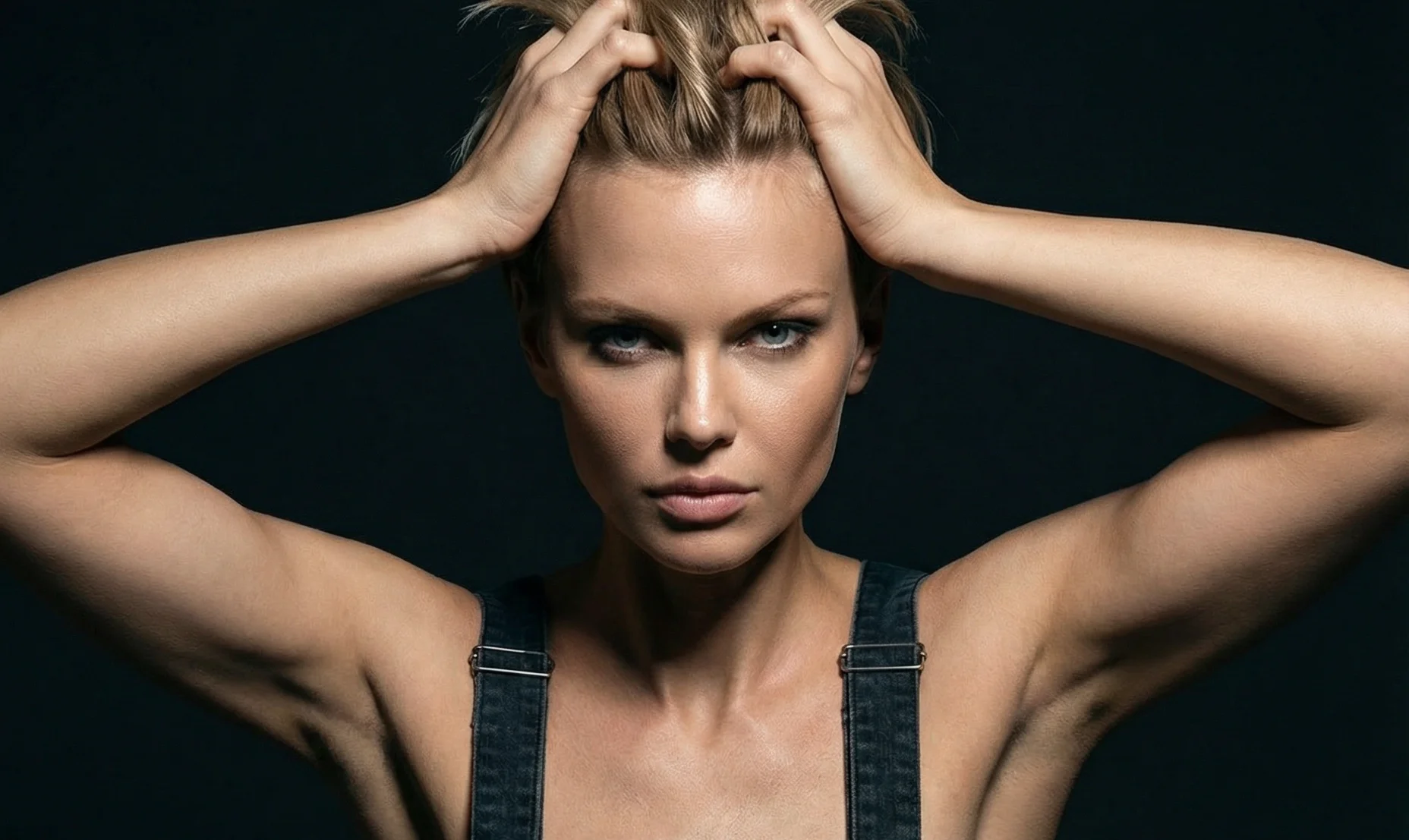

Prompt. The word comes up constantly when talking about AI. Better prompts, shorter prompts, the perfect prompt. But no one explains what it actually is.
A prompt is an instruction. A piece of text you give to an AI to tell it what you want. That’s all.
But — and here’s the difference — not every instruction works equally well.
Compare it to briefing a photographer.
Suppose you ask a photographer: "Take a nice photo of my dress." What do you get? Something. Maybe nice, maybe not. The photographer doesn’t have enough to work with and fills in the rest themselves.
Now you say: "I want a full-length shot, daylight from the left, model with weight on the right leg, dress fully visible including hem, light background." That photographer knows exactly what to do.
An AI works exactly the same way. Vague in, vague out. Precise in, precise out.
What can you actually ask?
Much more than most people think. You can describe a pose. A location. An atmosphere. The direction of the light. How a fabric moves. Whether the model is sitting, standing, leaning, or walking. Whether the background is white, dark, outdoors, indoors.
You can say: "Hair moves in the wind." Or: "One hand in the pocket, other arm relaxed along the body." Or simply: "Beach, summer, warm light."
The AI translates that into pixels.
Why does a Zappa prompt work better?
Because Zappa isn’t vague. The engine analyzes your reference image and describes exactly what is visible — in the language AI understands. No interpretation, no guessing. Every sentence is verifiable. Every instruction is reproducible.
The difference between "elegant pose" and "weight on the right leg, torso slightly turned to camera left, right shoulder slightly higher than left" — that’s the difference between hoping and knowing.
Zappa is the best school for prompts there is.
And that’s not an exaggeration. Every prompt Zappa generates is a lesson. You see how a pose is converted into precise language. You see how light is described without cinematic nonsense. You see how clothing is physically described instead of vaguely suggested.
After ten prompts you understand the structure. After twenty you recognize what works. After a hundred you have your own prompt library — an archive of shoots, moods, and styles you can reuse and adjust again and again via Correct Prompt.
Zappa doesn’t just teach you to make prompts. It teaches you to think like an AI — precise, visual, verifiable. And in the meantime, without realizing it, you’re building the best tool there is: your own experience.
And what can you do with it all?
Build a complete production collection without a photo studio. Your model, your clothing, your atmosphere — generated on demand. Today a sleek studio, tomorrow a beach, the day after tomorrow an industrial loft. Same model, same quality, completely different world.
That’s what a good prompt does. And that’s what Zappa arranges for you.
You don’t have to learn it. You use Zappa — and the learning happens automatically.